
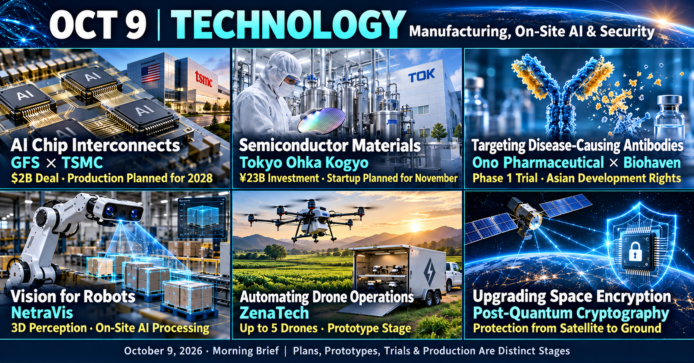

This morning’s key development is that competition in AI and drug discovery is expanding into investment in manufacturing and reliable real-world deployment. Developments include AI chip interconnects in the United States, semiconductor materials in Japan, robotic perception and control in Europe and India, and drug manufacturing capacity and personalized treatment in healthcare.
For investors, technical performance is only part of the picture. When can the technology enter mass production? Has it reached the point where customers will pay for it? Will higher revenue translate into profit? These three questions determine how research progress connects to corporate value.
This report reflects information reviewed on the morning of October 9, 2026, Japan Standard Time. It focuses on October 8 announcements, supplemented by recent trade publications and primary sources. Earlier announcements are labeled as background. Corporate targets, prototype specifications, and clinical trial progress are distinguished from completed achievements.
🇺🇸🇹🇼 1. GlobalFoundries and TSMC Announce a $2 Billion AI Chip Interconnect Agreement
On October 8, GlobalFoundries announced a manufacturing agreement to establish a U.S.-based supply of silicon interposers for TSMC’s CoWoS, an advanced packaging technology that integrates computing chips and high-performance memory. An interposer is an intermediate substrate that connects multiple chips through fine wiring. The multiyear agreement is valued at $2 billion, with an initial five-year term. (GlobalFoundries, October 8)
The company plans to expand capacity at its Malta, New York, facility, with volume production scheduled to ramp up in the first half of 2028. Expanding the supply of advanced AI chips requires more than manufacturing the computing chips themselves. It also requires the capacity to connect them with memory and assemble finished products. This agreement aims to establish a U.S. source for one of those critical components.
For investors, this shows that companies outside the most advanced chip manufacturing processes can also benefit from AI demand. Applying existing manufacturing technologies and equipment to interconnects, power components, and supporting devices can create a different path to earnings growth. However, the $2 billion agreement should not be treated as a single year’s revenue.
Key items to track are capital expenditures, customer qualification progress, and utilization after volume production begins. Expectations for 2028 revenue may be reflected in the stock price before then, while construction and development costs arrive earlier. The size of the order and the timing of cash recovery should be evaluated separately.
Related stocks: GFS — GlobalFoundries; TSM — Taiwan Semiconductor Manufacturing Company, through its U.S.-listed ADR (a security that allows shares of a foreign company to trade in the U.S. market).
🇯🇵 2. Tokyo Ohka Kogyo Completes a ¥23 Billion Manufacturing Building; Operations Planned for November
On October 8, Tokyo Ohka Kogyo announced the completion of a new semiconductor photoresist manufacturing building at its Koriyama facility in Fukushima Prefecture, Japan. Photoresist is a light-sensitive material used to form microscopic chip circuits. The investment totals approximately ¥23 billion, and the building has a footprint of 4,800 square meters. Operations are scheduled to begin in November. (Tokyo Ohka Kogyo, October 8)
The Koriyama facility produces advanced materials, including those used in EUV lithography (chip patterning with extremely short-wavelength light). The concrete progress in this announcement is that the planned investment has reached building completion and is approaching operational startup. The company is also advancing production-line automation and digitalization.
In semiconductor materials, producing large quantities is not enough. Trace impurities and variations in quality can lead to defects in customers’ products. Consistent output, stable quality, and reliable delivery allow a supplier to become deeply embedded in a customer’s manufacturing process.
For earnings, watch utilization after the expansion and the share of higher-value products in sales. Even after construction is complete, higher depreciation expenses (the cost of equipment allocated over its useful life) can reduce margins until revenue catches up. The company says the impact was already included in its earnings forecast released in August. Building completion should not be mistaken for an additional upward revision to that forecast.
Related stock: 4186 — Tokyo Ohka Kogyo, listed in Japan.
🇮🇳🇪🇺 3. Better Vision for Robots: NetraVis Combines Depth Sensing and AI Processing
India’s e-con Systems introduced its NetraVis 3D camera in conjunction with VISION 2026, an imaging trade show in Germany. It uses two viewpoints and supplemental illumination to measure distance. According to the company, specifications include one-megapixel resolution, a sensing range of up to six meters, and depth deviation of 0.5% or less at one meter. (e-con Systems / Edge AI and Vision Alliance, October 8)
At one meter, 0.5% equals five millimeters. This conversion helps explain the specification; it does not guarantee five-millimeter accuracy for every material and lighting condition. The camera includes an NPU (a specialized processor for AI calculations) that can also handle tasks such as object detection.
Robots need to know not only what an object is, but also where it is and how far away it is. For warehouse robots and equipment that picks up parts, reliable distance information directly affects task success. Moving recognition processing into the camera may also reduce the workload on the main computer.
Investors should focus on actual unit adoption and applications rather than trade-show reception. Relevant checks include performance with shiny metal, transparent containers, and low light; stability during prolonged use; and the effort required for replacement and calibration. When evaluating robotics growth, cameras, sensors, and embedded computing devices deserve attention alongside robot manufacturers.
Direct investment in e-con Systems should be distinguished from investment in related semiconductor companies. NVIDIA Jetson connectivity is identified as a future product development, not evidence of current sales from that adoption.
🇺🇸🇮🇳 4. SiMa.ai and Wobot.ai Aim to Turn Surveillance Video into Operational Improvements
The partnership between SiMa.ai and Wobot.ai was featured by an imaging industry alliance on October 8; the original company announcement was dated October 5. The companies will run video analytics for stores and factories on SiMa.ai’s Modalix AI processing platform. The setup allows analysis within a facility without sending video outside it. (SiMa.ai / Edge AI and Vision Alliance, Announced October 5; published October 8)
The goal goes beyond detecting anomalies and issuing alerts. It includes improving service speed, hygiene management, and work procedures. Edge AI (AI running on devices close to where data is generated) can reduce communication delays and video transmission costs. It also suits organizations that want to keep data on-site.
More analytics features do not necessarily mean more profit. Customers gain economic value only when the technology reduces the burden of reviewing footage or lowers costs related to waiting, waste, or incident response. Too many false alarms can increase the workload instead.
Metrics to watch include the rate at which pilots become production deployments, cost per store, and contract renewal rates. Scalability across facilities also matters. If each location requires substantial customization, labor costs may grow alongside revenue. Margin expectations differ depending on whether the offering scales as a repeatable product or remains a series of customized projects.
🇯🇵 5. MocoVoice Offers Offline Transcription and Meeting Summaries
On October 8, mocomoco announced paid tablet-based trial kits for its MocoVoice voice AI, aimed at businesses and organizations. The system combines speech recognition with a local LLM (an AI model that understands and generates text on the device), processing audio without sending it outside the device. (mocomoco / PR TIMES, October 8)
Potential applications include healthcare, manufacturing, finance, government, and construction sites. On-device processing may be valuable for meetings involving patient or development information, and for work records in underground or mountainous locations with unreliable connectivity. Delivering preconfigured equipment makes the system easier to try at sites without dedicated IT staff.
In construction, practical usefulness depends on accurately recognizing work zones, component names, and change instructions, rather than simply recording site meetings. Readable text does not reduce verification work if quantities, responsible personnel, or deadlines are wrong. Recognition of specialized terminology and the time needed for corrections are critical.
This illustrates that large cloud-based AI systems are not the only route to business customers. However, on-device processing has limits in computing power and storage. Hardware, maintenance, and model update costs should be compared with the work hours saved. This announcement marks the start of paid trials, not an established record of large-scale deployment.
mocomoco is privately held.
🇪🇺 6. Siemens Starts with Industrial Problems When Combining Technologies
On October 8, Siemens described the next phase of Cre8Ventures: combining robotics, digital twins, semiconductors, photonics, quantum technologies, and other tools around specific industrial problems. A digital twin is a computer-based representation of a physical asset or process used to test its behavior. (Siemens, October 8)
Examples include helping robots adapt quickly when production lines change or operate reliably without communications or positioning signals. This is an update to a framework for technology development and commercialization, rather than an announcement that a specific new product has entered mass production.
The economic opportunity is to reduce the cost of discovering problems after equipment has been built. Testing sensors, controls, and mechanical behavior together before prototyping or modifying a site may reduce rework. The approach shares a principle with BIM (building information modeling, which manages a building’s geometry and associated information together): integrate information early to identify problems.
However, success in a computer model does not mean that wear, dirt, lighting, and human activity have been fully reproduced. Investors should track examples that move from virtual validation to physical testing and sustained customer use. Including quantum technology in a framework does not demonstrate an advantage over conventional computing.
🇺🇸🇨🇦 7. ZenaTech Begins a Mobile Operations Trailer Prototype for Up to Five Agricultural Drones
On October 8, ZenaTech announced that it had begun building a mobile trailer to support agricultural drone charging, replenishment, takeoff, and landing. The design targets support for up to five drones, with testing planned over the coming months. The accompanying IQ Octo is also in prototype testing. Its design specifications include approximately 20–25 minutes of flight per charge and a maximum payload of 25 kilograms. (ZenaTech, October 8)
Flight time alone does not determine productivity in automated drone operations. What matters is daily job capacity after accounting for charging, refilling liquids or seeds, transport, cleaning, and inspections. The trailer focuses on reducing ground downtime.
Under the company’s DaaS model (providing drone-based work as a service rather than only selling aircraft), margins may improve if the same crew can cover more acreage. However, a design that supports five drones does not mean that output will automatically increase fivefold.
Practical evaluation requires area covered per hour, replenishment time, crew size, and availability in adverse weather. Both the drone and the mobile base remain prototypes. This announcement should not be treated as a completed operational capability. Test results and the start of customer service are the next milestones.
Related stock: ZENA — ZenaTech.
🇺🇸 8. Qualcomm and OKSI Develop Autonomous Systems for Limited-Connectivity Environments
Qualcomm’s government technologies division and OKSI announced a collaboration to deploy OKSI’s OMNISCIENCE autonomy software on Qualcomm technology. Optimized for the QCS8550 processor, it handles functions such as visual positioning and object recognition on the device. The companies plan to showcase it at a U.S. Army-related exhibition on October 12–14. (Company announcement / Edge AI and Vision Alliance, Published October 8)
Military and industrial unmanned systems can lose capability when communications fail if they depend too heavily on external connections. Onboard perception and decision-making provide a foundation for continued operation where connectivity is limited. This challenge also applies to industrial uses such as remote inspections.
The companies emphasize using an existing semiconductor manufacturing base to make autonomous capabilities easier to deploy at scale. For investors, the question is how much a combination of general-purpose chips and software can shorten the development cycle for specialized equipment.
A collaboration announcement is not a procurement contract. Actual adoption volumes, long-term supply, reliability testing, and responsibility for software updates still need to be evaluated. In defense, supplying the required quantities at the required time can be as important to business value as performance.
Related stock: QCOM — Qualcomm.
🇩🇪🇺🇦 9. Background: Scaling Production of Ukrainian Drone Technology in Germany
Quantum Frontline Industries, a joint venture between Germany’s Quantum Systems and Ukraine’s Frontline Robotics, secured a follow-on supply contract for Ukraine’s National Guard for 2027. The October 5 company announcement covers the Linza and Zoom platforms and says the venture is preparing to increase production capacity fivefold in 2027. (Quantum Systems announcement / Vertical, October 5)
The economic significance is the combination of field experience from Ukraine and manufacturing infrastructure in Germany. Separating development from volume production aims to support both rapid improvements and reliable supply. Despite the word “Quantum” in the company names, this announcement does not concern quantum computing.
A follow-on order indicates continued customer need. However, a fivefold capacity increase is a plan, not evidence that deliveries or revenue have already increased fivefold. Components, inspection capacity, funding, and staffing must all scale together.
The investment theme extends beyond better drone performance to supply chains and volume manufacturing processes. Evaluating defense technology commercialization requires separate tracking of prototype success, field use, follow-on orders, and completed deliveries.
🇯🇵🇺🇸 10. Ono Pharmaceutical Acquires Asian Rights to Drugs That Degrade Disease-Causing Antibodies
On October 8, Ono Pharmaceutical announced an agreement to obtain exclusive development and commercialization rights in Japan, South Korea, Taiwan, and ASEAN countries for three IgG-degrading drugs developed by Biohaven: BHV-1300, BHV-1310, and BHV-1320. IgG is a type of antibody; autoantibodies are antibodies that mistakenly attack the body’s own tissues. (Ono Pharmaceutical, October 8)
The most advanced candidate, BHV-1300, is undergoing a Phase 3 trial for Graves’ disease. Phase 3 is the stage in which efficacy and safety are evaluated in larger patient populations ahead of a potential approval application. The treatment aims to remove antibodies involved in causing the disease. It could offer an additional option that addresses the underlying disease mechanism rather than only controlling symptoms.
Terms include an $80 million upfront payment, $20 million in payments tied to specified milestones, and royalties of approximately 20% of sales. Ono will handle development, regulatory approvals, and subsequent commercialization. This is a regional licensing agreement, not an acquisition of Biohaven itself.
Investors should look beyond antibody reduction to changes in symptoms, relapse, treatment continuation, and side effects. Drug sales do not translate entirely into profit: development costs, selling expenses, and royalties must be deducted. The impact on current-year earnings is described as minor, making future trial results and progress toward approval the main basis for evaluating value.
Related stocks: 4528 — Ono Pharmaceutical, listed in Japan; BHVN — Biohaven.
🇺🇸 11. Viatris Agrees to Acquire Non-Opioid Pain Treatment Company Pacira for $1.65 Billion
On October 8, Viatris announced a definitive agreement to acquire Pacira BioSciences for $36.50 per share in cash. The equity value is approximately $1.65 billion, with closing expected by year-end. Key products include EXPAREL and ZILRETTA. Opioids are drugs that provide strong pain relief but can carry risks such as dependence. (Viatris, October 8)
For the trailing 12 months through June 2026, Pacira reported approximately $746 million in revenue and $177 million in adjusted EBITDA. EBITDA is earnings before interest, taxes, depreciation, and amortization; the adjusted figure also incorporates company-specified adjustments. This transaction acquires products already on the market and an established commercial operation.
A simple calculation puts the equity purchase price at approximately 2.21 times revenue. Adjusted EBITDA represents approximately 23.7% of revenue. However, the purchase-price comparison uses equity value, not the value of the entire business including debt and cash. Adjusted EBITDA also should not be treated as equivalent to net income.
The technology angle is that value comes not only from a drug’s active ingredient but also from formulation technology that prolongs its effect by controlling delivery and release in the body. Investors should review patents, competing products, sales expansion, and integration costs. If the acquisition closes, Pacira is expected to become a wholly owned subsidiary and be delisted.
Related stocks: VTRS — Viatris; PCRX — Pacira BioSciences. The transaction has been agreed to but has not yet closed.
🇺🇸 12. Background: Multiply Labs Moves from AI Drug Discovery to Robotic Drug Manufacturing
Multiply Labs announced a $75 million funding round on October 6, followed by coverage in healthcare trade publications on October 7–8. The company automates complex manufacturing processes, including cell and gene therapies, with robotics. AstraZeneca and Teradyne are among the new investors. (Multiply Labs announcement / Business Wire, October 6)
The approach combines robotics with existing manufacturing equipment and workflows to automate repetitive tasks and transfers between process steps. Funding will support manufacturing capacity, product development, and staffing. Advances that generate more drug candidates cannot expand patient access unless those treatments can also be manufactured safely at scale.
Healthcare manufacturing requires contamination prevention, recordkeeping, and reproducible quality as well as speed. The goal is not simply to reduce staffing as in an ordinary factory. Manufacturers must follow product-specific approved procedures and demonstrate quality. The extent to which automation can be integrated into approved processes will influence adoption speed.
Investors should track installations in commercial production, maintenance revenue, consumables revenue, and repeat customer orders rather than focusing only on the funding amount. Investing in a publicly traded backer is different from investing directly in this private company. The funding round alone does not establish a substantial earnings impact for those investors.
Multiply Labs is privately held. Related publicly traded companies include AZN — AstraZeneca and TER — Teradyne.
🇰🇷🇮🇸🇺🇸 13. LOTTE Biologics and Alvotech Partner on U.S. Manufacturing of Antibody Medicines
On October 8, South Korea’s LOTTE Biologics and Iceland’s Alvotech announced a long-term manufacturing partnership. They plan to produce drug substances for multiple antibody biosimilars at a facility in Syracuse, New York. A biosimilar is a medicine developed to match an existing biologic in quality, efficacy, and safety. (Company announcement / PR Newswire, October 8)
The facility has 40,000 liters of bioreactor capacity. That volume cannot be directly converted into quantities of marketable medicine. Actual output depends on cell productivity, culture duration, cleaning and changeover time, and product-specific quality requirements.
The economic significance is the use of a U.S. manufacturing base to support drug supply across multiple regions. Commercial supply follows technology transfer, manufacturing qualification, and necessary approvals. Signing the agreement does not mean shipments of commercial products have already begun.
In contract manufacturing, demonstrated quality and durable customer relationships are strengths alongside equipment capacity. Underused facilities, however, allow fixed costs to weigh on profit. Watch the number of products, time required for technology transfer, the start of commercial shipments, and utilization. Reliable manufacturing is becoming increasingly important behind the competition in drug discovery.
🇯🇵 14. DOCOMO Plans a Trial to Personalize Hand Rehabilitation Using Movement Data
On October 8, NTT DOCOMO and Seiwakai announced a trial beginning December 1 to personalize rehabilitation for patients with hand and finger paralysis. The project combines an assistive device based on Hiroshima University research with DOCOMO’s Human Augmentation Platform and FEEL TECH. (NTT DOCOMO, October 8)
A camera measures finger movements on the unaffected hand, while an artificial-muscle glove assists the affected hand. The system records joint angles, range of motion, alignment with a reference movement, and training repetitions, comparing these with the patient’s own historical data. It aims to adjust exercises and assistance as recovery progresses.
The notable development is the connection between movement assistance and measurement. Patients may find it easier to see changes, while clinicians gain more information for planning exercises. The value of wearable technology (devices worn on the body) is expanding from wearing a device to obtaining data that supports daily decisions.
This is not an announcement of established treatment efficacy. The trial will assess usefulness and operational issues, with results to be analyzed from fiscal 2027 onward. Investors should consider improvement, clinician workload, the burden of putting on the device, and continued patient use.
Related stock: 9432 — NTT, listed in Japan. NTT DOCOMO is not separately publicly traded.
🇯🇵🇲🇾 15. SoftBank, Grab, and PETROS Explore AI Infrastructure in Sarawak
On October 8, SoftBank Group, Grab, and Malaysian energy company PETROS signed a framework agreement to explore AI and digital infrastructure development in Sarawak. They will evaluate a phased development plan covering computing infrastructure, AI services, robotics, and workforce development. (SoftBank Group, October 8)
SoftBank contributes technology networks including AI and semiconductors; Grab contributes its Southeast Asian user and business network; and PETROS contributes expertise in energy supply and regional infrastructure. The project considers computing facilities, electricity, and customer access together.
For investors, the important feature is that both infrastructure builders and potential users are part of the same concept. When facilities are built ahead of demand, low utilization can increase the financial burden. Capturing regional service demand will be a condition for recovering the investment.
Investment size, facility scale, and operating dates have not yet been specified. A framework agreement is not a major order or the start of construction. The next items to track are feasibility studies, power supply terms, implementation entities, funding responsibilities, and customer contracts.
Related stocks: 9984 — SoftBank Group, listed in Japan; GRAB — Grab Holdings.
🇨🇳 16. Background: China’s New Battery Plan Emphasizes Production Scale and Quality by 2030
A new battery industry plan issued by China’s Ministry of Industry and Information Technology and six other departments drew attention in market coverage on October 8. The original policy was published on September 28. Targets for 2030 include initial scaled deployment of all-solid-state batteries, a 15,000-cycle charge/discharge life for long-life lithium batteries, and improved product defect rates at major companies. (China’s Ministry of Industry and Information Technology, September 28)
All-solid-state batteries use a solid material to conduct ions inside the battery. These figures are policy targets, not performance already achieved by commercially available products. The all-solid-state and long-life battery targets also should not be combined into a single product specification.
The plan covers materials, manufacturing equipment, software, quality management, and recycling. Strong laboratory performance does not guarantee adoption unless manufacturing defects, material costs, and degradation over long-term use are addressed. Production processes and evaluation methods will influence commercialization.
Investors should distinguish pilot production equipment from facilities producing batteries for sale. The 15,000-cycle life target also requires checking the temperature, charge/discharge rate, and depth of discharge used in testing. Useful comparisons include cost per kilowatt-hour, loss of usable capacity, and maintenance costs after installation.
The policy could create both demand opportunities and competitive pressure for Japanese materials and equipment suppliers. However, the reviewed documents do not establish orders for any particular Japanese company.
🇫🇮 17. Background: Xiphera Integrates Post-Quantum Cryptography into a Chip’s Trust Foundation
Finland’s Xiphera announced nQrux Root of Trust for integration into semiconductors. The original announcement was dated September 30, while the official page displays an October 5 publication date. A root of trust protects device authenticity and cryptographic keys and provides a foundation for checking whether other functions can be trusted. (Xiphera, Announced September 30; published October 5)
The offering draws on development work with the European Space Agency and includes post-quantum cryptography (encryption and related methods designed to resist attacks by future powerful quantum computers). It is designed as pure digital circuitry without relying on a CPU or firmware.
Space and industrial equipment remain in service for many years, making future cryptographic updates a concern alongside current security. Incorporating protection at the chip design stage may reduce the complexity of adding safeguards after a product is complete.
However, post-quantum cryptography alone does not make an entire device secure. Key storage, update procedures, and manufacturing controls also matter. Investors should track design wins and whether the devices using the technology enter volume production. A technology licensing announcement can precede recurring revenue by a substantial period.
🇨🇭🇪🇸 18. WISeSat and FOSSA Confirm an October Satellite Launch Plan
On October 8, WISeSat.Space and Spain’s FOSSA Systems confirmed a satellite launch planned for October and described development plans for the QSOC satellite platform. The concept progressively integrates post-quantum cryptography, device authentication, and cryptographic key protection into satellites, ground stations, and connected terminals. (WISeSat.Space announcement / GlobeNewswire, October 8)
The announcement describes a system combining proprietary satellites, partner satellites, and ground networks. Expanding satellite communications requires more than connectivity. It also requires controls over who connects and who can access data.
Although the terminology includes “quantum,” this announcement centers on encryption and authentication for satellite infrastructure. It does not describe commercial operation of a general-purpose quantum computer in space. Confirming a launch plan also differs from a successful launch or the start of communications service.
The next milestones are launch, orbital deployment, ground communications checks, demonstrations of protection features, and paid customer use. Satellite businesses incur development and launch costs before revenue begins. Technical progress should be evaluated alongside funding needs.
Related stock: SAIQ — WISeSat.Space Holdings. Availability through Japanese brokers requires separate confirmation.
🇺🇸 19. Background: Combining 509 MW of Solar Capacity with 1.4 GWh of Battery Storage
ContourGlobal’s Project Sterling in Arizona combines 509 megawatts of solar capacity with a 360-megawatt, 1.4-gigawatt-hour battery system. Official materials describe the project as under construction, targeting commercial operation in 2028, and identify a long-term power agreement with Tesla. This is background for understanding power investment, not an October 8 announcement of a new technology. (ContourGlobal, Reviewed October 9)
Megawatts measure power output at a given moment; gigawatt-hours measure stored energy. Dividing 1.4 gigawatt-hours by 360 megawatts gives approximately 3.9 hours, consistent with the company’s description of roughly four hours of storage. That does not mean the system can cover every prolonged power shortage.
A solar project’s value is not determined solely by annual generation. Delivery during periods of demand, grid access, and electricity pricing also matter. Batteries can shift daytime generation to periods such as the evening, but charging and discharging losses and degradation must be considered.
When tracking electricity demand from AI facilities, generation, storage, transmission, and purchase agreements should be evaluated together. These materials do not establish that the project supplies a particular Tesla AI facility. Watch construction schedules, grid connection, equipment costs, and contracted electricity revenue.
🇯🇵 20. Remote Equipment Monitoring Package Includes Three Years for Less Than ¥100,000
On October 8, RATOC Systems launched an introductory promotion for an LTE-enabled temperature and equipment monitoring device. LTE uses cellular networks for connectivity. The temperature monitoring package includes hardware, a five-meter temperature sensor, and a three-year license for ¥99,800 before tax. It can send alerts without installing a new internal LAN or Wi-Fi network. (RATOC Systems / PR TIMES, October 8)
This is a commercial update that reduces upfront costs and installation effort, rather than the invention of a new measurement principle. Starting with a single refrigerator, warehouse location, or server room suits businesses that cannot undertake major equipment upgrades.
Dividing the pretax ¥99,800 price by 36 months gives approximately ¥2,772 per month. This is not an all-inclusive monthly fee covering installation and other costs. To assess the actual benefit, compare inspection time saved with losses avoided through earlier detection of problems.
For investors, products that can spread widely through small initial deployments are worth watching. Revenue can grow from one site to several, rather than relying only on large upfront contracts. However, monitoring does not mean automatic repair. An effective response process after an alert helps determine whether customers renew.
RATOC Systems is privately held.
🌐 Global Watch: What Matters This Morning
In the United States and Taiwan, supply-chain plans for interconnects that support AI computing became more concrete. Japan saw progress in a semiconductor materials plant and on-site technologies for healthcare and business operations. In Europe and India, robotic perception devices and design and validation frameworks stood out.
South Korean and European pharmaceutical companies are advancing partnerships using U.S. manufacturing facilities. China’s battery policy broadens the focus from research performance to manufacturing scale and quality. For Ukraine-related developments, this report includes background on a follow-on contract linking development with overseas production.
Russia, North Korea, and other markets were also reviewed, but this report does not include developments for which novelty and the stage of technical realization could not be sufficiently verified. In power generation, cooling, finance, space, and quantum technology, a newly published article is likewise not a reason to describe an older technology as a new invention.
📊 Investor Comparison: How Far Is Each Development from Commercial Deployment?
| Development | Confirmed Stage | What to Track Next |
|---|---|---|
| Tokyo Ohka Kogyo’s new manufacturing building | Completed; operations planned for November | Utilization, product mix, margins |
| GFS–TSMC interposers | Five-year agreement; volume production ramp planned for the first half of 2028 | Capital spending, qualification, production ramp |
| Ono Pharmaceutical–Biohaven | Regional licensing agreement; lead candidate in Phase 3 | Trial results, safety, approval |
| NetraVis | Product announcement | Unit adoption, real-world performance |
| ZenaTech’s mobile operations base | Prototyping and preparation for testing | Work output, replenishment time, service launch |
| DOCOMO’s rehabilitation technology | Trial planned to start in December | Usefulness, operational burden, practical deployment |
| Sarawak AI infrastructure | Framework agreement | Project scale, power, funding, customers |
| Viatris–Pacira | Acquisition agreement | Closing, integration costs, sales growth |
📈 Three Ways to Connect Technology News with Earnings
First, identify why customers would pay. Check whether faster, smarter, or smaller technology reduces work hours, lowers defect rates, or creates more sales opportunities. Measurable customer benefits make it easier to assess the likelihood of renewals and additional adoption.
Second, consider the cost of increasing supply. If factories, equipment, staffing, and working capital must grow as quickly as revenue, little cash may remain for shareholders. The additional expense required to generate additional revenue is a key measure.
Third, track timing. A factory starting operations this fiscal year, a component entering volume production in 2028, a drug awaiting approval, and a drone not yet tested have different paths to profit. Rather than grouping them all as “growth technologies,” monitor whether their schedules advance or slip.
From a probability perspective, technical success, customer adoption, and successful mass production are separate conditions. For illustration, if the probability of passing each successive stage is assumed to be 80%, the probability of passing all three is 0.8 × 0.8 × 0.8 = 51.2%. This is not an estimate for any specific company. It is a way to avoid treating prototype success as a guarantee of future revenue.
When reviewing financial results, examine operating margins and cash flow after capital expenditures alongside revenue growth. A logarithmic scale (a scale where equal percentage or multiple changes occupy equal distances) can also help compare growth over several years. It makes growth rates at large and small companies easier to compare without the difference in company size dominating the view.
📝 Closing Thoughts
This morning’s announcements highlight the importance of companies that connect computing, materials, manufacturing, perception, and security. Investment ideas can come not only from better AI models and new drug candidates, but also from the technologies that enable volume production and reliable use at customer sites.
My pick for further research today is Tokyo Ohka Kogyo’s new manufacturing building. Approximately ¥23 billion of investment has reached completion, with operations planned to begin soon, in November. The first priority is to track how utilization and higher-value material sales translate into profit, rather than move directly to a buying decision.